Predicting per-stroke force curves from video-only biomechanics. Two synchronized data streams converge during training; inference uses video alone. Click any stage to inspect data contracts.
Monocular rowing video → Sports2D / MotionBERT pose estimation
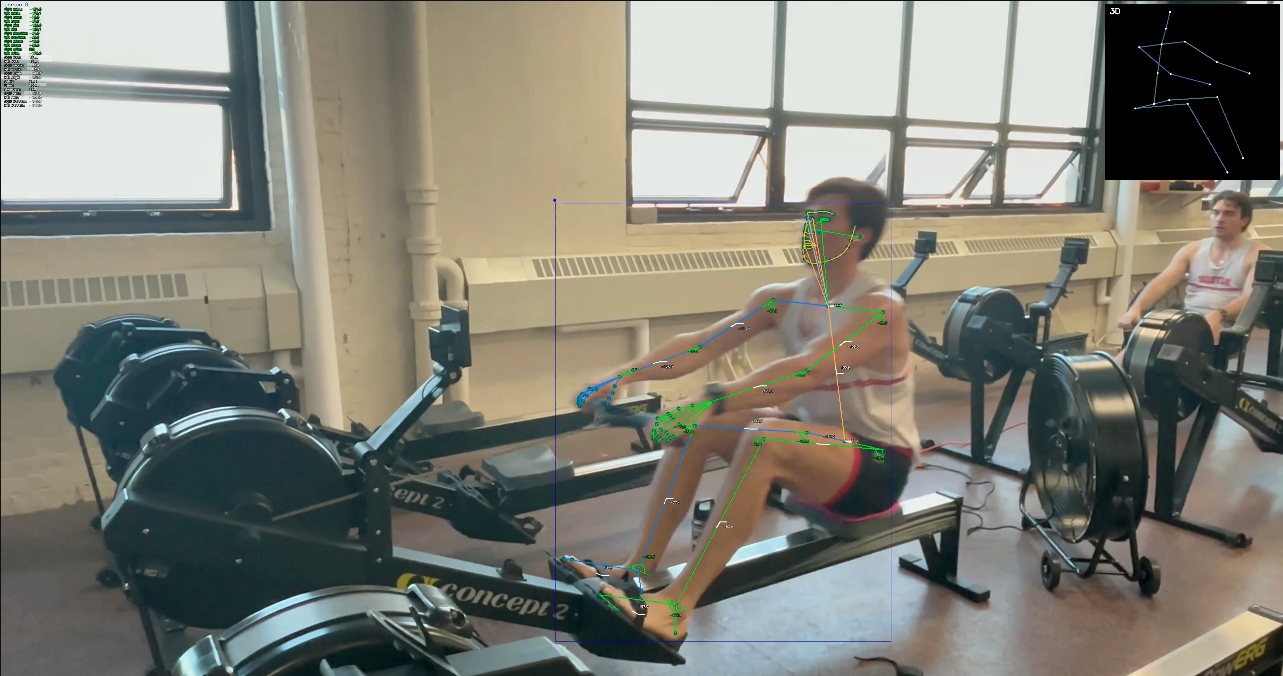
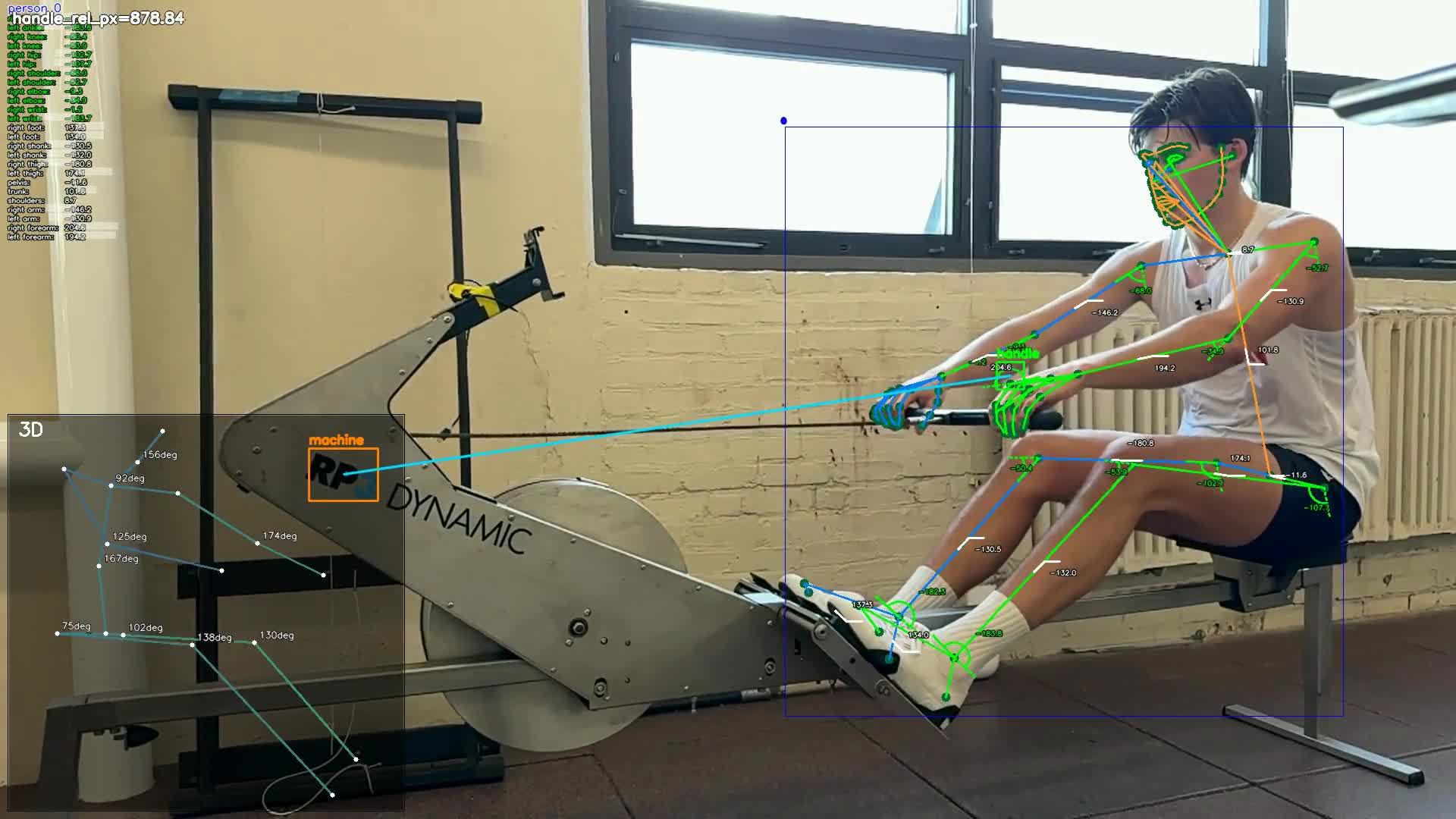
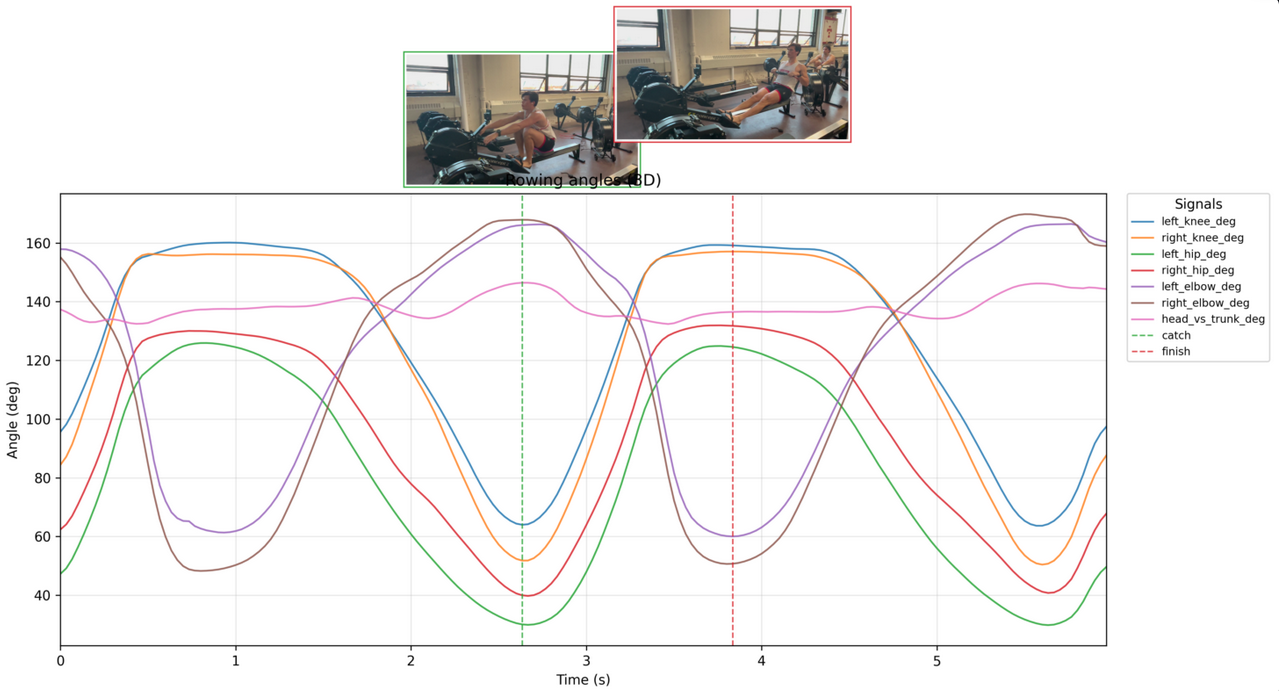
The sports2d_app pipeline processes monocular video through MotionBERT 3D lifting to extract H3.6M skeleton landmarks and compute joint kinematics frame-by-frame.
Sports2D pose overlay: smooth keypoint trajectories under self-occlusionHandle proxy (hand midpoint) and machine reference tracking
angles_h36m.csv
frame_idx, time_s
left/right_knee_deg, hip_deg, elbow_deg
trunk_vs_horizontal_deg, spine_flexion_deg
head_vs_trunk_deg
stroke_signal.csv
frame_idx, time_s, handle_cx/cy_px
relative_axis_px, velocity_axis_px_s
stroke_idx, stroke_phase, is_drive
is_catch, is_finish
RP3 Force Data▶
Ergometer force exports → cleaned per-stroke force-at-distance bins
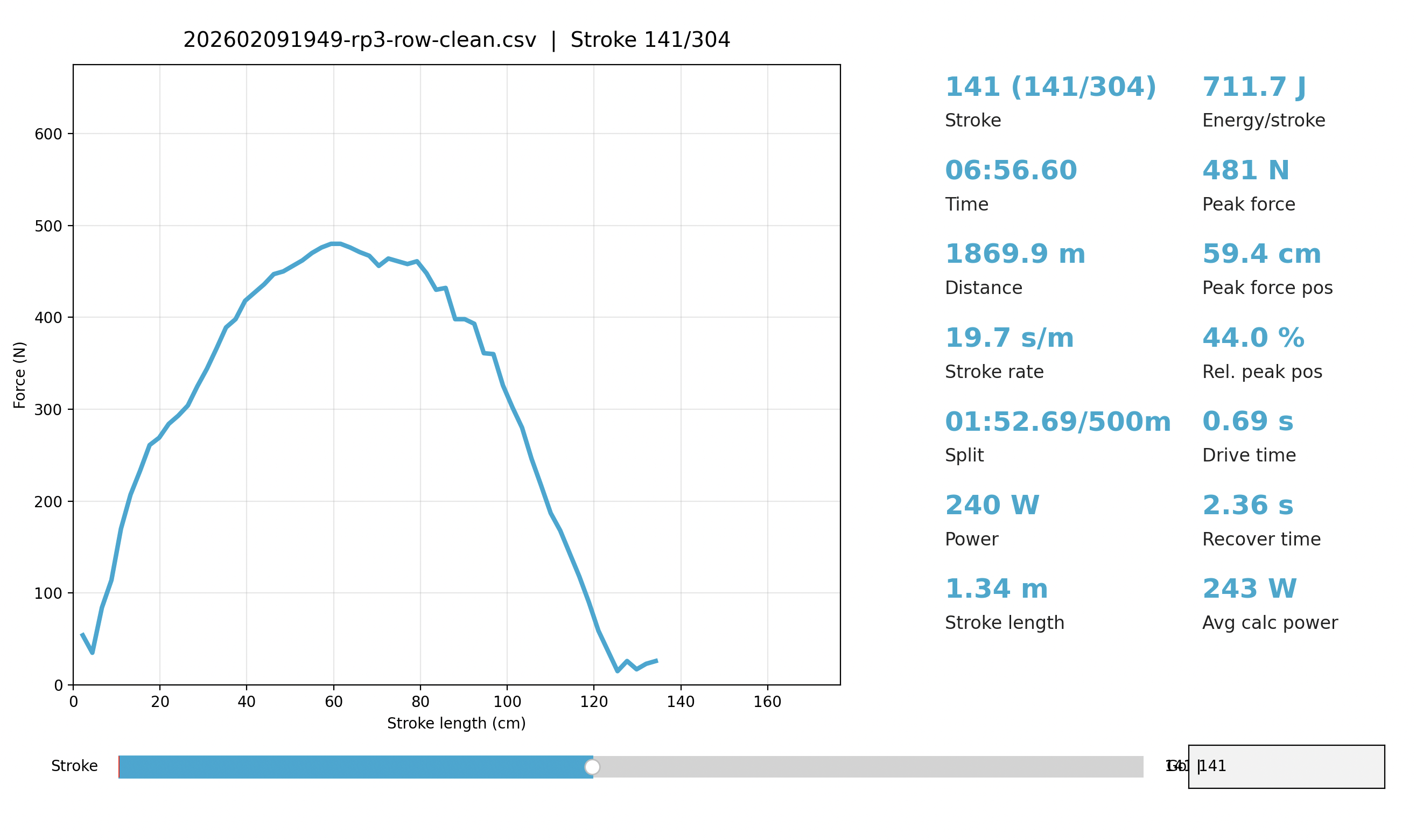
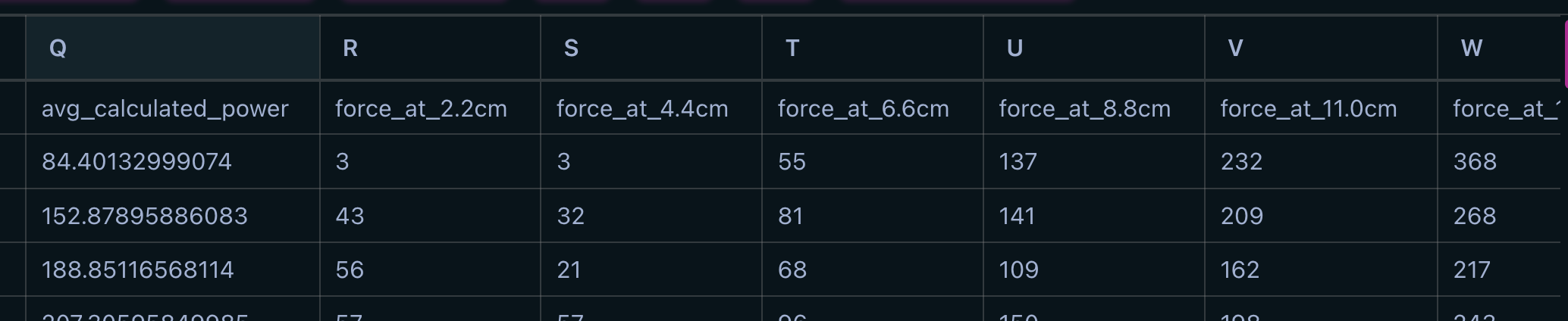
Raw RP3 exports are cleaned by inference_cli.py and expanded by expand_rp3_curve_data.py into spatially-sampled force bins at 2.2 cm intervals along the drive.
Per-stroke force curves reconstructed from cleaned RP3 data (2.2 cm distance bins)
*-clean.csv (expanded)
stroke_number, time, stroke_length
peak_force, peak_force_pos, rel_peak_force_pos
drive_time, recover_time
force_at_2.2cm, force_at_4.4cm, … force_at_Ncm
02Unilateral Standardization
Single-Side Biomechanics Mapping▶
Camera-near side becomes the canonical limb chain; sign conventions normalized across sessions
Each session declares an active_side (left or right) and a rower_facing (left or right). The canonical mirror policy lives in inference/feature_contract.py and is shared by training and video-only inference: unsigned flexion angles (knee_active_deg, hip_active_deg, elbow_active_deg, spine_flexion_deg, head_vs_trunk_deg) are facing-invariant; only trunk_vs_horizontal_deg is flipped (180−θ) when facing left.
Catch/finish boundary detection → isolate drive portions per stroke
Uses stroke_signal.csv flags: drive starts at catch, ends at finish. Only the drive portion is supervised against RP3 force curves.
Joint angles, handle position, and stroke-phase markers from a single video
Per stroke
catch_frame, finish_frame
drive_frames[]: frame indices during drive
feature_curves[]: angle values at drive frames
RP3 Stroke Structure▶
Each RP3 row = one stroke; force sampled at 2.2 cm spatial bins along the drive
RP3 data is already per-stroke. Force values are sampled at fixed spatial intervals along the drive distance. The stroke length determines how many bins are valid.
Cleaned RP3 data: each sample at a fixed 2.2 cm step in stroke length
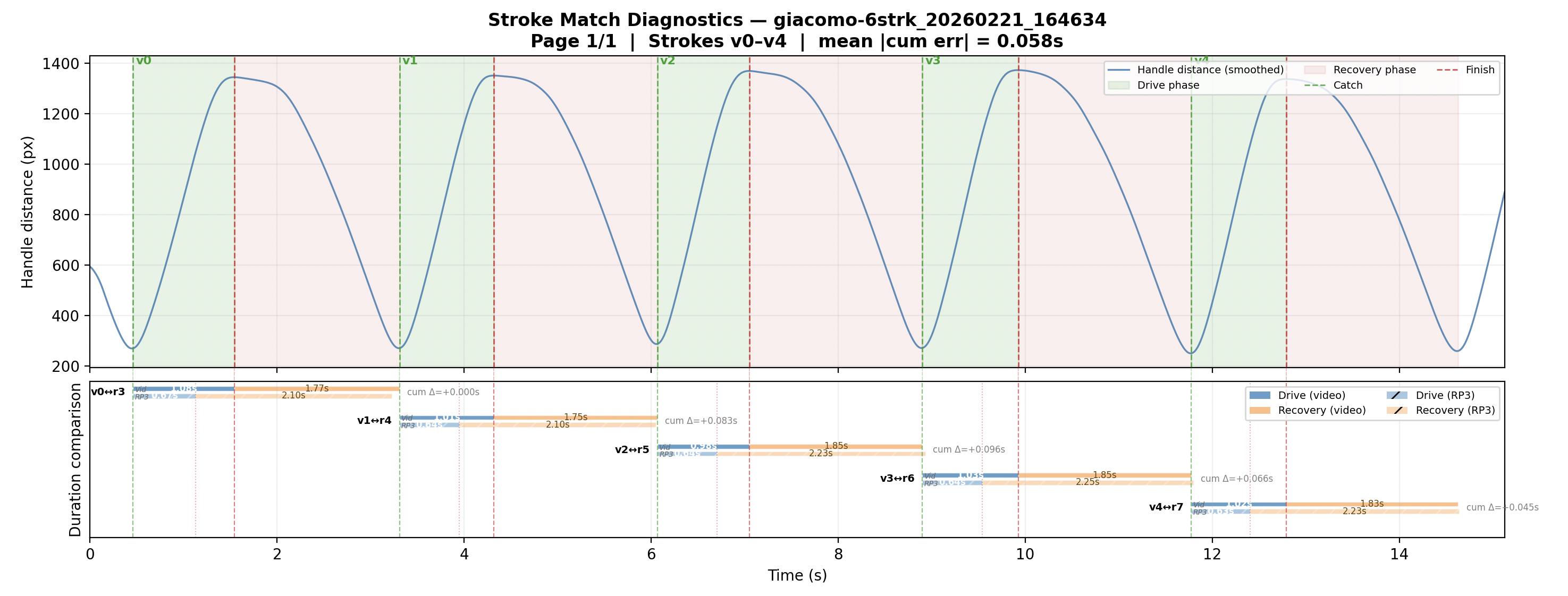
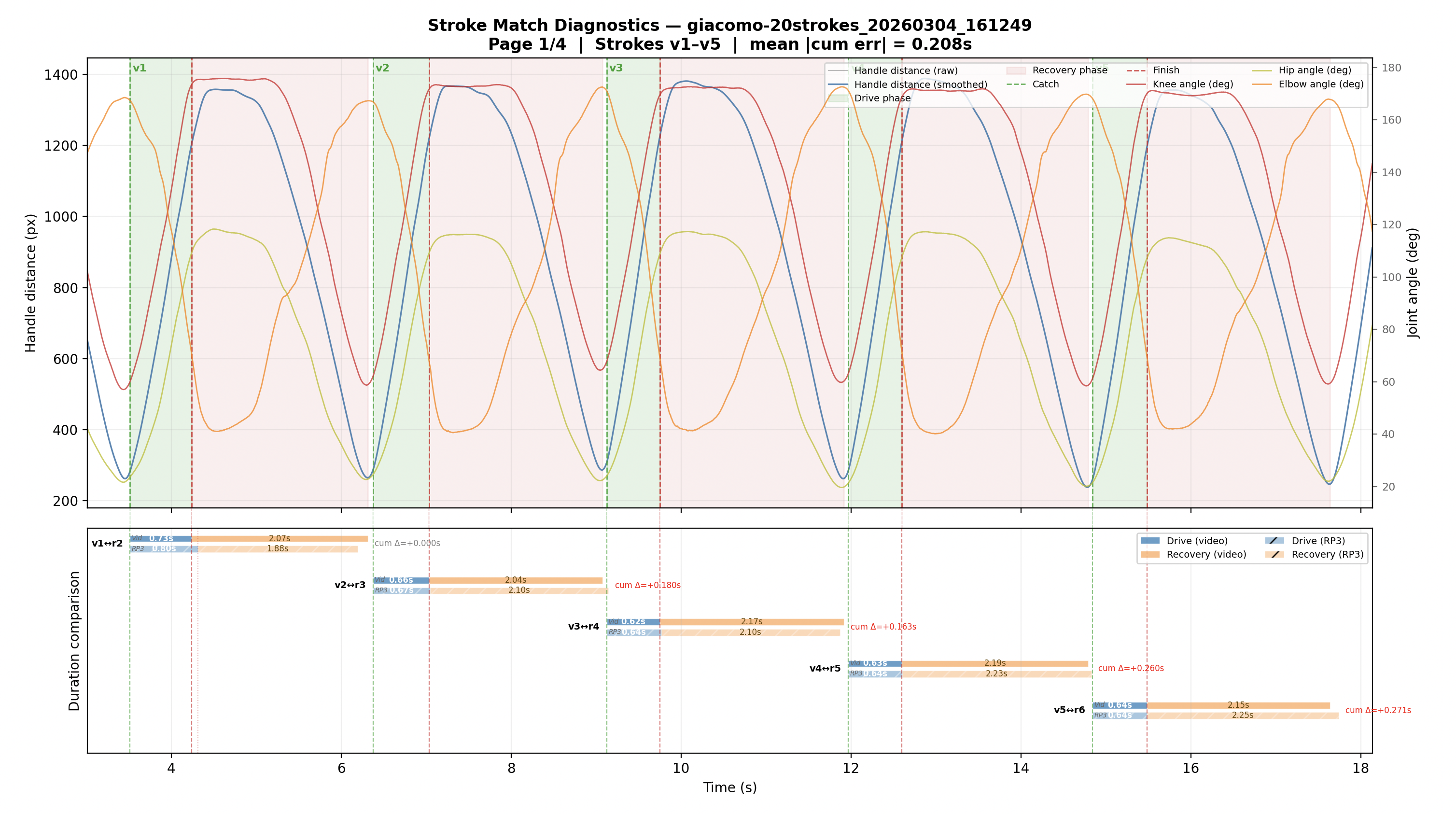
Auto-pair from session registry → cross-correlation coarse anchor → DP fine sync → drift-gated pairing manifest
Auto-pair:inference/pair_session.auto_pair_run resolves active_side, rower_facing, athlete ID, RP3 clean CSV, and (optional) registry-provided anchor from session_registry.csv, so match_rp3_cli.py --auto-pair does not need per-run flags.
Coarse:coarse_sync_anchor cross-correlates video and RP3 cycle-duration sequences and proposes the RP3 row that pairs with a reference video stroke. This is the default anchor resolver when no explicit anchor is given (disable with --no-xcorr-anchor; trust gated by --xcorr-max-cost).
Fine: Dynamic-programming stroke match over catch/finish boundaries with the coarse anchor locked.
Drift gate:--reject-on-drift (default on) hard-fails pairings whose cumulative or mean per-stroke interval error exceeds --drift-reject-max-cum-err-s / --drift-reject-mean-interval-err-s — reject rather than emit silently-misaligned labels.
↳ Video + RP3 streams merge in normalized progress space
05Drive-Domain Alignment
Normalized Progress Grid s ∈ [0, 1]▶
All signals mapped to normalized drive progress — not wall-clock time, not pixels
The master domain is normalized drive progress s. This decouples the representation from frame rate, stroke speed, and physical distance.
RP3 side:s_force = d_k / stroke_length_cm
Video side:s_video from drive phase progression signal.
Video features are interpolated from s_video to s_force grid. No pixel-to-cm calibration is needed in this iteration.
Per stroke, aligned
s = [0.00, 0.02, 0.04, …, 1.00]
X(s): kinematic features at each s
Y(s): force at each s (training only)
06Feature Engineering
Angle Curves & Derivatives▶
Smoothed angles → dθ/ds via chain rule → optional d²θ/ds²
Smoothing: Fixed Savitzky-Golay kernel (small odd window, low polynomial order) applied to raw angle trajectories.
Chain rule:dθ/ds = (dθ/dt) / (ds/dt + ε)
Second derivatives included only if ablation shows clear gain. Strokes with ds/dt ≈ 0 or non-physiological spikes are rejected.
The per-stroke feature sequence builder (inference/segment_features.py) is shared by the training-side inference_cli.py and the video-only predict_force_cli.py. The no-RP3 variant build_pose_drive_segments emits features on the bundle's s_grid without needing any force data.
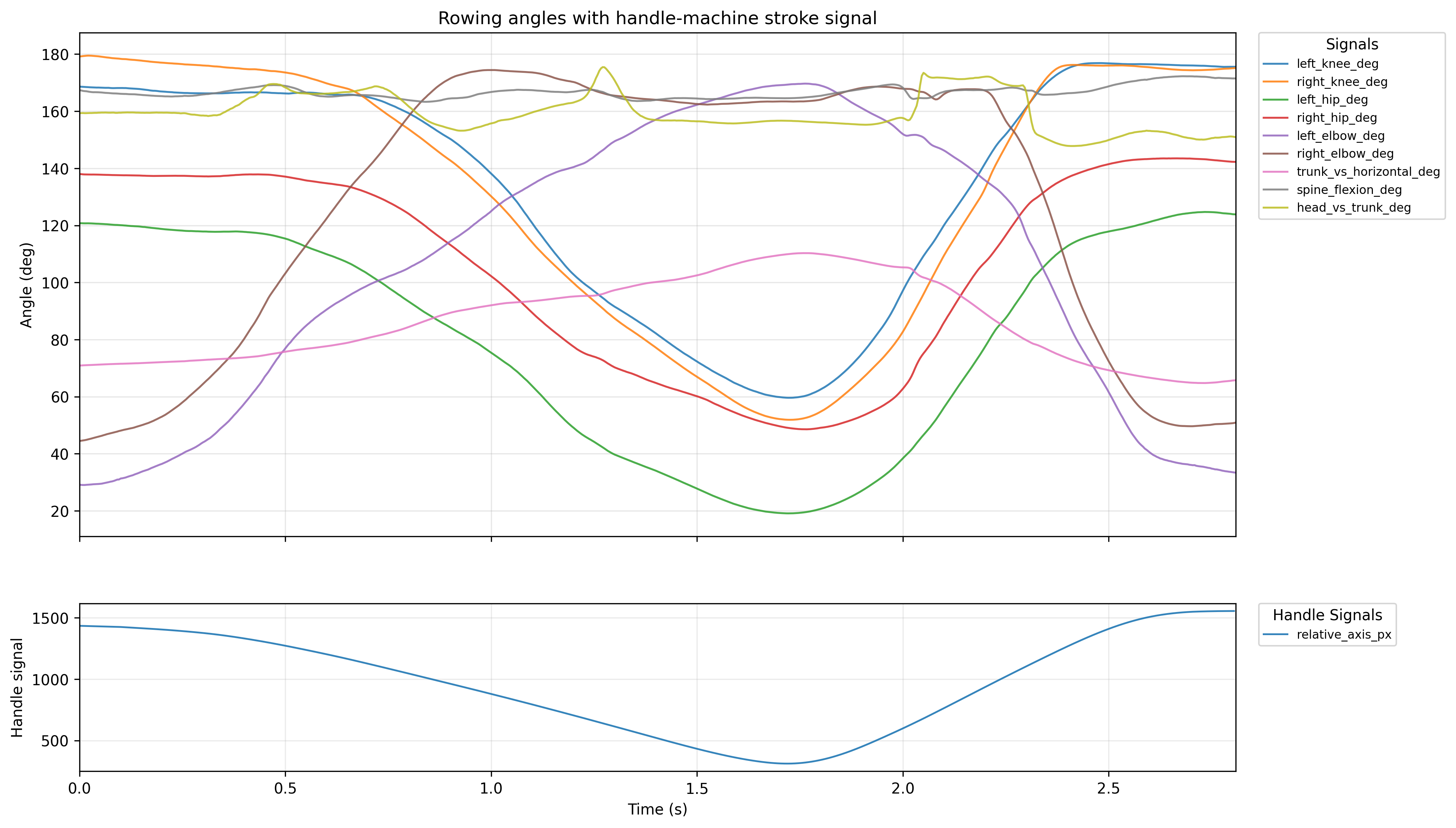
High-precision kinematic traces: the raw angle signals before derivative computation
Phase lags, angle ratios, handle kinematics; stroke rate & drive ratio as context
Coordination: Phase timing lags (legs → swing, swing → arms) and angle ratio features at key progress points.
Support: Handle velocity/acceleration projected onto the drive axis.
Context: Stroke rate, drive ratio as scalar conditioning variables.
Coordination
leg_swing_lag, swing_arm_lag
leg_trunk_ratio(s), trunk_arm_ratio(s)
Support & context
handle_vel_axis(s), handle_acc_axis(s)
stroke_rate, drive_ratio
QCQuality Control & Failure Modes
Six per-stroke flags → hard/soft classification → aggregate quality score
QC Gate PipelineEach stroke passes through six independent checks producing flags and a composite score
Stroke flows top-to-bottom through six checks; hard flags reject, soft flags record; five sigmoid penalties multiply into the composite score
Progression Monotonicity▶
Detects when handle progress required silent repair via maximum.accumulate
The normalized progress signal s_video should be monotonically increasing during the drive. When the raw signal has backwards segments (tracking glitches), np.maximum.accumulate forces monotonicity —
but this distorts the progress axis and corrupts chain-rule derivatives.
Metric:progress_mono_violation_frac — fraction of drive frames where the raw value was below the running maximum.
Measures boundary sharpness via velocity contrast at catch and finish
Strokes with mushy, ambiguous catch/finish boundaries have misplaced drive windows, directly corrupting the label alignment between video features and RP3 force curves.
Velocity contrast: computed as the difference in mean |slope| across a short window on each side of the boundary, normalized by peak drive velocity. High = sharp reversal, low = gradual transition.
Three new fields on DriveEvent: catch_velocity_contrast, finish_velocity_contrast, drive_prominence.
Duration Plausibility▶
Simple physiological range check on drive and cycle durations
If a detected drive is 0.15 s or 3.5 s, it cannot be a real rowing stroke — the detection failed. This trivial range check catches outliers that the velocity-based detector missed.
Drive range: [0.4, 2.0] s. Cycle range: [1.5, 4.0] s.
Classification: hard drop — implausible durations mean the label alignment is corrupted.
Constants (inference_cli.py)
DRIVE_DURATION_MIN_S = 0.4
DRIVE_DURATION_MAX_S = 2.0
CYCLE_DURATION_MIN_S = 1.5
CYCLE_DURATION_MAX_S = 4.0
Aggregate Quality Score▶
Product of per-dimension sigmoid penalties → single [0, 1] confidence value
Rather than just binary flags, a continuous score enables soft weighting during training and gives end-users a trust signal during inference.
Aggregation: multiplicative — any single bad dimension drives the composite score toward zero (AND-logic, not averaging).
Five penalty dimensions each mapped through a smooth sigmoid from "good" (penalty ≈ 1) to "bad" (penalty ≈ 0):
_compute_quality_score()
nan_frac → good < 0.05, bad > 0.3
max_deriv_deg_s → good < 300, bad > 600
mono_violation_frac → good < 0.05, bad > 0.15
detection_confidence → good > 0.30, bad < 0.15
drive_duration_s → good [0.6, 1.5], bad outside [0.4, 2.0]
Target representationStandard PCA or functional PCA (B-spline + PCA) — selected via --target-representationSame diagram on model training page
Force curve target encoding: raw curves → peak-normalized → PCA coefficients (20 components)
Stage 0 — Sanity Baselines▶
Force reproducibility floor + metadata-only regression — the bar biomechanics models must clear
Reproducibility floor: Quantify within-condition variability of force curves (same athlete, similar stroke rate/length bins). Median pairwise curve distance, coefficient of variation.
Metadata baseline: Regress force-curve PCA coefficients from scalar metadata only (stroke rate, length, drive time). Reconstruct predicted curves. Every biomechanics model must beat this.
Stage 0: establish the reproducibility floor (0a) and metadata-only prediction baseline (0b)
Stage A — Interpretable Kinematic Models▶
Stroke-level summary features + coordination scalars → regularized linear / tree ensembles → PCA or fPCA coefficients
Verifies that kinematic features add value beyond metadata. Identifies dominant explanatory biomechanics features through feature importance analysis. Target representation is selected per-run (--target-representation standard|fpca); both families can coexist in the same dataset directory.
Stage A: stroke-level scalar features → classical ML → PCA force-curve coefficients
Stage B — Sequence Models▶
Full progress-aligned kinematic sequences → TCN / Transformer encoder → full force curve
Temporal convolutional network or transformer encoder operating on the full progress-aligned feature sequences. Architecture selected via --stageB-arch {tcn, transformer}; captures nonlinear stroke dynamics and cross-joint interactions.
Conditioning: Coordination scalars (onsets, lags, range fractions, drive_ratio) are broadcast as constant extra input channels when --stageB-use-coordination is set — no separate scalar head.
Loss: Masked pointwise MSE using the per-stroke force_mask; optional derivative regularizer gated by --stageB-lambda-deriv.
Artifacts: Each run saves state.pt, arch_config.json, feature_norm.npz, and target_norm.npz from the best CV fold, plus architecture-suffixed copies for cross-arch comparison.
Stage progression: each stage must beat the previous on the same metrics
08Prediction & Output
Force Curve Prediction▶
Video-only CLI loads a self-describing model bundle → predicts per-stroke force curve + derived metrics
At inference, no RP3 input is used. inference/predict_force_cli.py --run-dir <run> --model-dir <bundle> loads a portable model_bundle/, runs drive detection, extracts pose features via segment_features.build_pose_drive_segments, runs Stage A or Stage B prediction depending on what the bundle contains, and writes normalized curves, an RP3-style cm-indexed force table, and derived metrics.
Evaluation: consistent splits and metrics across all stages for fair comparison
Curve-Level Metrics▶
RMSE / MAE over force bins, per-stroke curve correlation
Standard regression metrics over all valid force bins in the hold-out set.
RMSE(F, F̂), MAE(F, F̂)
Pearson r per stroke
Rowing-Relevant Metrics▶
Peak force error, peak position error, impulse error, phase-specific errors
Metrics that matter to coaches and athletes — the downstream quantities that inform technique feedback.
peak_force_error (N)
peak_position_error (% drive)
impulse_error (N·s)
early / mid / late drive phase errors
Cross-Representation / Cross-Architecture Report▶
evaluation_report.json + text report group by target_representation and stage_b_arch
Every run annotates its overall metrics with target_representation (standard / fpca) and stage_b_arch (tcn / transformer). write_evaluation_report merges prior-run artifacts in the same output directory so PCA vs fPCA and TCN vs Transformer are compared head-to-head on the same held-out strokes, without clobbering either.
evaluation_report.json — grouped by representation & arch
evaluation_report.txt — human-readable comparison
Video pipeline
RP3 force data (training)
Shared processing
Inference output
Quality control gate
Click any card to toggle data contracts. Use the view switcher to focus on training or inference paths. For Stage 0–B training flows and evaluation metrics, see model training diagrams.